
Table of Contents
Introduction :
On Page vs Off Page SEO is a fundamental concept in search engine optimization and one of the most powerful ways to grow your online presence organically. Whether you run a blog, an eCommerce store, or a business website, SEO helps your content reach the right audience at the right time. However, SEO is not just one single activity—it is broadly divided into On-Page SEO and Off-Page SEO, each serving a distinct purpose in improving search visibility.
Many beginners often ask:
Which one matters more—On-Page or Off-Page SEO?
The truth is, both play a critical role, but in different ways and at different stages of your SEO journey.
In this blog, we’ll break down On Page vs Off Page SEO, explain their key differences, and reveal the best 8 SEO tactics you should focus on to improve rankings, organic traffic, and website authority in a sustainable way.
What Is SEO and Why It Matters?
SEO is the process of optimizing your website so that search engines like Google can easily understand, index, and rank your content for relevant search queries. To build a strong SEO foundation, it’s important to understand On Page vs Off Page SEO, as both play a crucial role in improving search visibility. When done correctly, SEO helps you:
- Increase organic website traffic
- Improve brand visibility
- Build trust and credibility
- Generate long-term leads and sales
SEO works on three main pillars:
- On-Page SEO
- Off-Page SEO
- Technical SEO
While technical SEO focuses on backend elements like site speed and indexing, this blog will mainly focus on On Page vs Off Page SEO, as these two pillars directly influence content performance and authority.
What Is On-Page SEO?
On-Page SEO refers to all the optimization activities you perform inside your website. The biggest advantage of On-Page SEO is that it consists of elements you have complete control over. When comparing On Page vs Off Page SEO, On-Page SEO focuses on content quality, keyword placement, internal linking, and technical structure
The primary goal of On-Page SEO is to:
- Help search engines understand your content
- Improve user experience and readability
- Match search intent accurately
Common examples of On-Page SEO include:
- Keyword optimization
- Content quality and structure
- Meta tags (title & description)
- URL structure
- Internal linking
- Image optimization
Without strong On-Page SEO, even the most powerful backlinks won’t help your site rank consistently. This is why, in the debate of On Page vs Off Page SEO, on-page optimization is often considered the foundation.
What Is Off-Page SEO?
Off-Page SEO includes all the actions taken outside your website to improve its authority, trust, and relevance. These activity helps ranking potential by analysing how others perceive your brand online. In the discussion of On Page vs Off Page SEO, Off-Page SEO focuses on building backlinks, brand mentions, social signals, and online reputation.
The main goals of Off-Page SEO are to:
- Build website credibility
- Signal trust to search engines
- Improve domain authority
Examples of Off-Page SEO include:
- Backlink building
- Brand mentions
- Social media signals
- Guest blogging
- Influencer outreach
Search engines treat Off-Page SEO as a vote of confidence from other websites. In the comparison of On Page vs Off Page SEO, off-page efforts help your site compete in high-competition keywords.
On-Page vs Off-Page SEO : Key Differences
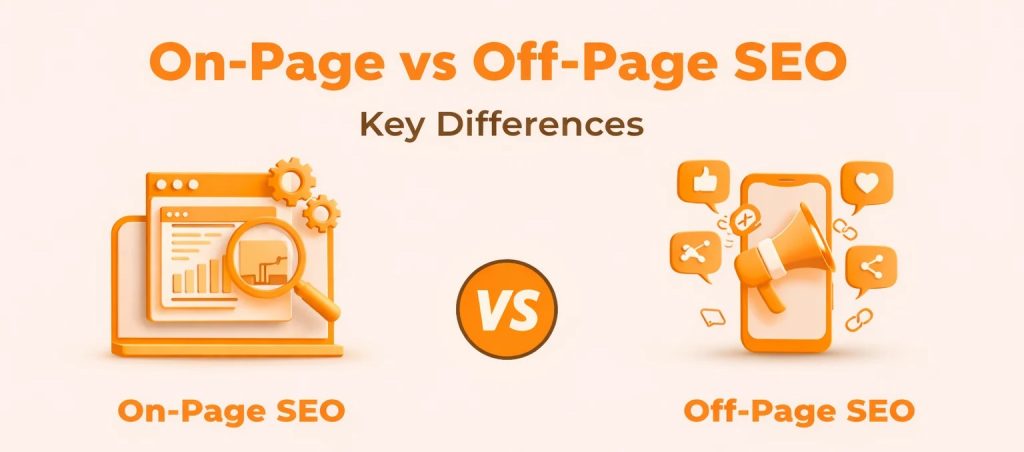
| Aspect | On-Page SEO | Off-Page SEO |
|---|---|---|
| Control | Fully under your control | Partially under your control |
| Focus | Content & structure | Authority & trust |
| Impact | Helps rank for relevance | Helps rank for competitiveness |
| Time | Faster improvements | Long-term results |
| Dependency | Foundation of SEO | Depends on strong On-Page SEO |
Both are interconnected. You cannot succeed with only one, as On-Page SEO builds a strong foundation while Off-Page SEO strengthens authority and trust. When comparing On Page vs Off Page SEO, it’s clear that each supports the other to improve overall search performance. A well-balanced On Page vs Off Page SEO strategy helps search engines understand your content, trust your brand, and rank your website consistently. Together, they create a sustainable approach that drives long-term growth and stable search rankings.
Best 8 SEO Tactics You Must Follow :
1. Smart Keyword Research & Placement (On-Page SEO)
Keyword research is the backbone of On-Page SEO and a crucial factor in On Page vs Off Page SEO success, as it helps identify what your target audience is actively searching for. Using the right keywords ensures your content matches search intent and attracts relevant, high-quality traffic. If you target the wrong keywords, your content won’t rank—no matter how good it is.
Best practices:
- Focus on search intent (informational, commercial, transactional)
- Use long-tail keywords for easier ranking
- Place keywords naturally in:
- Title tag
- Meta description
- Headings (H1, H2)
- First 100 words
- URL
- Image alt text
Avoid keyword stuffing. Google prefers natural, user-focused content.
2. High-Quality, Helpful Content (On-Page SEO)
Content is still king—but only when it provides real value by solving user problems and answering their queries clearly. High-quality content improves dwell time, reduces bounce rate, and strengthens your position in On Page vs Off Page SEO competition. According to Google’s official SEO guidelines, creating helpful, people-first content is essential for long-term search visibility.
Google rewards content that is:
- Original and in-depth
- Easy to read and well-structured
- Answer-focused and user-centric
Tips for better content:
- Write for humans first, search engines second
- Use short paragraphs and bullet points
- Add examples, data, and explanations
- Update content regularly
If your content solves a problem better than competitors, rankings will follow.
3. Optimizing Title Tags & Meta Descriptions (On-Page SEO)
Your title and meta description are the first things users see in search results, making them crucial for attracting clicks. Strong metadata can significantly impact how your page performs in On Page vs Off Page SEO results. They directly affect your click-through rate (CTR).
Best practices:
- Title length: 52–62 characters
- Meta description: 135–160 characters
- Use power words and numbers
- Add a clear CTA like “Read Now” or “Must Read”
A higher CTR sends positive signals to Google, improving rankings over time.
4. Internal Linking & URL Structure (On-Page SEO)
Internal linking improves crawlability and user navigation, making it an essential tactic in On Page vs Off Page SEO. and improves user navigation by connecting related pages. Proper internal linking also helps important pages rank better by highlighting their relevance.
Benefits of internal linking:
- Passes link equity across pages
- Reduces bounce rate
- Helps index new pages faster
URL best practices:
- Keep URLs short and descriptive
- Avoid unnecessary numbers or symbols
- Include the main keyword
Example:example.com/on-page-vs-off-page-seo
5. Image Optimization & Page Experience (On-Page SEO)
Images improve engagement and make content more appealing to users. However, unoptimized images can slow down your website and affect performance. In the context of On Page vs Off Page SEO, image optimization is a crucial On-Page SEO factor that directly impacts page speed, user experience, and search rankings.
While Off-Page SEO builds authority through external signals, On Page vs Off Page SEO highlights how technical elements like optimized images support better visibility and performance in search results.
Optimize images by:
- Compressing file size
- Using descriptive file names
- Adding keyword-rich alt text
- Using modern formats like WebP
Page experience factors such as Core Web Vitals, mobile responsiveness, and fast loading speed are now direct ranking signals.
6. High-Quality Backlink Building (Off-Page SEO)
Backlinks serve as a primary indicator of authority in Off-Page SEO. In On Page vs Off Page SEO or Backlinks remain one of Google’s strongest ranking factors because they act as votes of trust from other websites. High-quality backlinks signal authority and credibility to search engines. They help improve rankings and drive referral traffic.
However, quality matters more than quantity.
Best backlink sources:
- Relevant niche websites
- High-authority blogs
- News and media sites
- Industry directories
Avoid spammy links or paid link schemes, as they can harm your rankings.
7. Brand Mentions & Authority Signals (Off-Page SEO)
Google doesn’t just track backlinks—it also tracks brand mentions across the web. Positive mentions signal relevance and credibility to search engines, strengthening your overall SEO performance over time. In the discussion of On-Page vs Off-Page SEO, brand mentions are a key Off-Page SEO factor that helps build trust and authority beyond your website
Even unlinked mentions of your brand across:
- Blogs
- Forums
- News sites
- Social platforms
…help build trust and authority.
How to improve brand mentions:
- Publish share-worthy content
- Collaborate with influencers
- Participate in online communities
- Get featured in expert roundups
The stronger your brand, the easier it is to rank.
8. Social Signals & Content Promotion (Off-Page SEO)
While social media links are usually no-follow, they still play a vital role in SEO by increasing content visibility and brand awareness. This indirect impact supports long-term SEO growth by driving traffic and encouraging engagement. In the context of On Page vs Off Page SEO, social media activity is an important Off-Page SEO signal that strengthens your online presence.
Benefits of social signals:
- Increase content visibility
- Drive referral traffic
- Improve content discovery
- Encourage natural backlinks
Promote your content on:
- Twitter (X)
- Reddit & Quora
More exposure means more chances to earn backlinks organically.
Which Matters More : On Page or Off Page SEO?
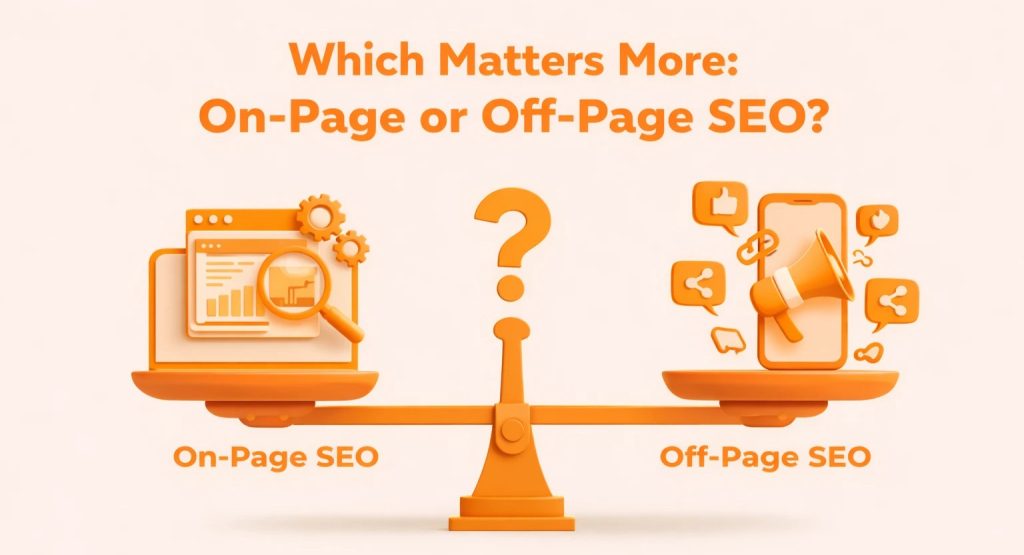
The honest answer: Neither works alone. When comparing On Page vs Off Page SEO, both work together to determine how well a website ranks in search engines. On-page SEO focuses on optimizing content, keywords, and technical elements to create a strong foundation, while off-page SEO builds authority through backlinks, brand mentions, and external signals. Neither works effectively alone—long-term SEO success depends on a balanced strategy that combines both.
- On-Page SEO is the foundation
- Off-Page SEO is the booster
If your On-Page SEO is weak, Off-Page efforts won’t convert into rankings.
If your Off-Page SEO is weak, your site won’t compete in high-competition keywords.
Best SEO Strategy:
- Perfect your On-Page SEO first
- Then scale with Off-Page SEO
- Monitor performance and refine continuously
Final Thoughts
Understanding On Page vs Off Page SEO is essential for building a sustainable SEO strategy. By applying the best 8 SEO tactics discussed above, you can create content that ranks well, earns trust, and drives long-term organic growth. However, SEO is not a ‘set it and forget it’ task; it requires consistent monitoring and refinement. Success lies in balancing technical precision with high-quality storytelling that resonates with your audience and satisfies search engine algorithms alike.” SEO is not about shortcuts—it’s about consistency, quality, and user value. Thank you for reading our “On Page vs Off Page SEO” blog.
If you’re serious about growing your website and want expert guidance, partnering with a professional digital marketing agency can help you avoid mistakes and achieve faster results. Digital Darter brings all digital marketing services together in one place to help brands grow visibility, gain quality leads, and succeed online. if you
If you found our “On-Page vs Off-Page SEO” blog helpful or have any suggestions to improve it, we’d love to hear from you. Share your thoughts in the comments—your feedback helps us create even better content for you.
Great post! The way you explained SEO strategies is very clear and practical. I especially liked the part about content quality and user intent. Thanks for sharing such valuable insights.